When the power goes out, the hum of a portable generator can feel like a lifeline. It brings light back to your home, keeps food cold, and perhaps, most importantly, keeps your internet running. But connecting that generator to your house isn't as simple as plugging it into an outdoor outlet. Done incorrectly, it can turn your temporary relief into a deadly hazard for utility workers and a dangerous risk for your own home. That's where Choosing the Right Generator Interlock Kit becomes not just a convenience, but a critical safety decision.
An interlock kit is the ingenious, yet simple, device that ensures your home's electrical system plays nice with both utility power and your generator, preventing a dangerous scenario called "backfeeding." It's a mechanical safeguard that makes accidental, simultaneous connection impossible.
At a Glance: Your Interlock Kit Essentials
- What it is: A mechanical safety device that physically prevents your main breaker and generator breaker from being on at the same time.
- Why you need it: To prevent deadly "backfeeding" of generator power into utility lines and to comply with the National Electrical Code (NEC).
- Key benefit: Allows you to power any circuit in your home, not just a few dedicated outlets.
- Cost: Kits are typically $50-$160, but professional installation adds $1,000-$1,500.
- Most critical factor: Panel compatibility. Your kit must match your specific electrical panel's brand, model, and main breaker amperage.
- Always ensure: The kit is UL-listed for safety.
- Professional installation is mandatory: Do not attempt to install an interlock kit or related electrical components yourself.
Why an Interlock Kit Isn't Just an Accessory, But a Necessity
Imagine this: your generator is humming, powering your fridge and a few lights. If that power accidentally flows back out onto the grid, it can electrocute unsuspecting utility workers who are trying to restore power. This horrific scenario, known as "backfeeding," is precisely what the National Electrical Code (NEC) Article 702.6 aims to prevent by mandating transfer equipment.
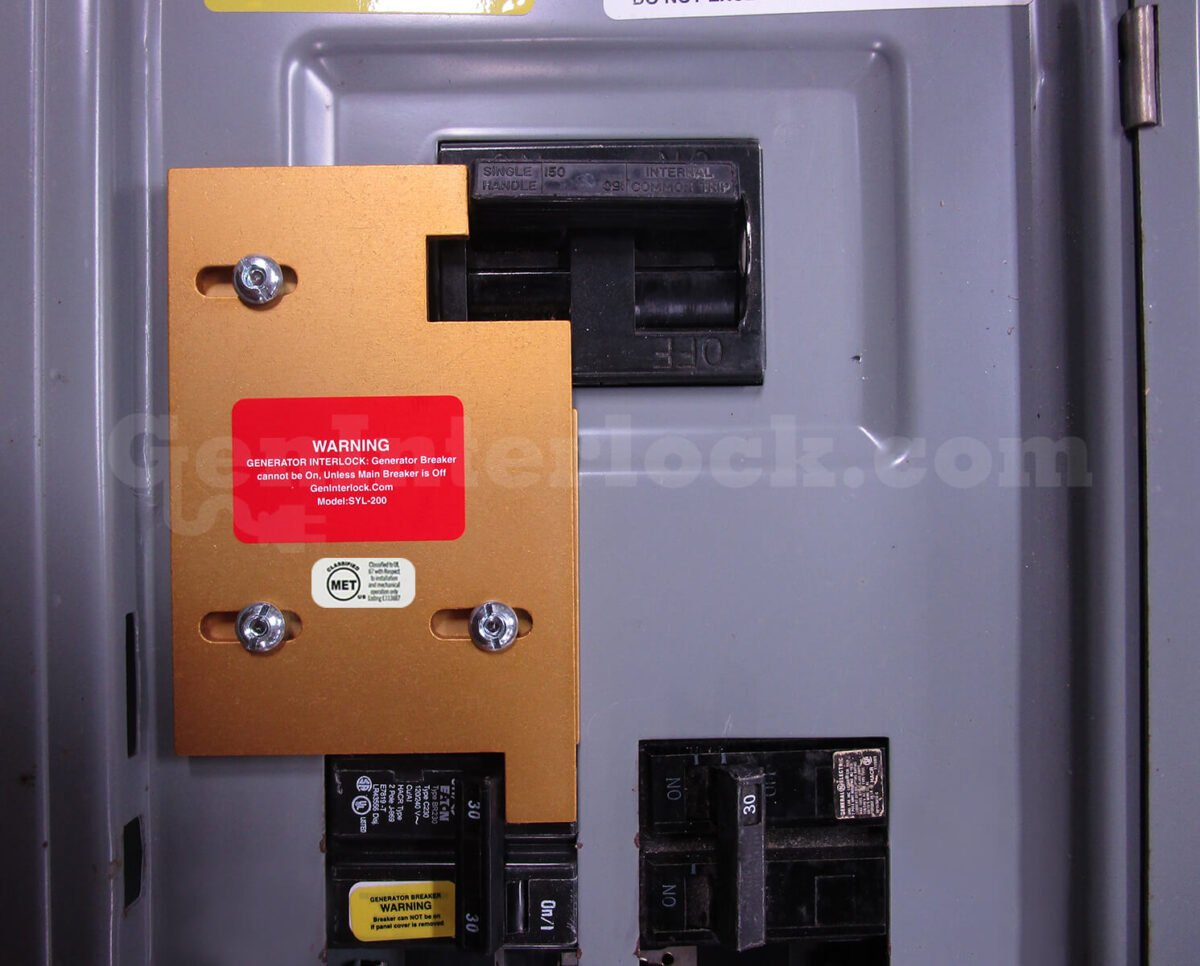
An interlock kit fulfills this mandate with elegant simplicity. It’s a mechanical plate that mounts over your electrical panel's main breaker and a newly installed generator breaker. Its brilliant design ensures that when your main utility breaker is on, the generator breaker is physically blocked from being flipped on. To engage generator power, you must first turn off the main breaker, then slide the plate to allow the generator breaker to turn on. This guarantees only one power source is active at any given time, providing a foolproof method to prevent backfeeding.
Beyond crucial safety, interlock kits offer several compelling advantages:
- Unparalleled Safety: As mentioned, they provide a mechanical, foolproof barrier against backfeeding. There's no complex wiring to misunderstand, just a physical plate dictating your actions.
- Budget-Friendly Power: Compared to automatic transfer switches (ATS), interlock kits are significantly more affordable. While an ATS can run $600-$2000+ for residential units and involves complex installation, an interlock kit itself typically costs just $50-$160. This makes whole-home backup power accessible to more homeowners.
- Whole-Home Convenience: Unlike extension cords that limit you to powering only devices near the generator, an interlock kit allows your portable generator to power virtually any circuit in your home via your main electrical panel. This means your furnace, refrigerator, well pump, and even essential lighting can stay operational.
- Manual Control: While an ATS offers automatic startup and load transfer upon an outage, an interlock kit gives you direct control. You decide when to start the generator and which circuits to power, managing your loads manually—a smart approach for portable generators with finite output.
For a deeper dive into the world of generator safety and connection options, you can explore Your guide to generator interlock kits. It's clear that an interlock kit is a foundational component for any homeowner planning to use a portable generator for backup power.
The Critical First Step: Understanding Your Electrical Panel
You wouldn't buy a car part without knowing your car's make and model, right? The same logic applies, even more critically, to generator interlock kits. These kits are not universal. They are highly specific, designed to integrate perfectly with particular electrical panel brands, models, and main breaker configurations. A mismatched kit isn't just ineffective; it's a significant safety hazard.
So, before you even start browsing, you need to become intimately familiar with your home's electrical panel. Here's how to identify what you have:
- Locate Your Panel: This is usually a gray metal box, often in a basement, garage, or utility closet.
- Open the Panel Door: This reveals the breakers inside.
- Identify the Brand: Look for labels or stickers inside the panel door or on the panel's interior wall. Common brands include Square D (QO/Homeline), Siemens, Eaton (CH/BR), GE, and Murray. This is paramount.
- Note the Model: Sometimes, the model series (e.g., QO, Homeline, CH, BR) will be listed alongside the brand.
- Determine Main Breaker Amperage: The largest breaker at the top of your panel is typically the main breaker. It will have a number like 100A, 150A, or 200A printed on it. This number represents your home's total electrical service capacity.
- Snap a Picture (Safely): With the cover open (but never touching any wires!), take a few well-lit photos of the interior labels and the main breaker. These will be invaluable when you're shopping or talking to an electrician.
Having this information—brand, model, and main breaker amperage—is non-negotiable. It's the foundation for choosing a compatible, safe, and code-compliant interlock kit. Without it, you're just guessing, and when it comes to electricity, guessing is never an option. For more context on the various components of your home's electrical nerve center, consider demystifying your home's electrical panel.
Key Buying Considerations: A Step-by-Step Checklist for Safety and Success
Once you understand your panel, you're ready to evaluate interlock kits. Think of this as your essential checklist to ensure you get the right fit, both for safety and functionality.
1. UL-Listing: Your Non-Negotiable Safety Seal
This is perhaps the most critical factor after compatibility. Always, always choose a UL-listed (Underwriters Laboratories) interlock kit. UL is a global safety certification company that tests products to rigorous safety standards. A UL-listed kit means it has been independently verified to meet strict safety and manufacturing requirements. Without this certification, you cannot be confident in the kit's reliability or its ability to perform its life-saving function when you need it most. Don't compromise here; your family's safety depends on it.
2. Breaker Spacing: Precision Matters
Interlock kits are engineered to fit a very specific physical layout within your electrical panel. This means the spacing between your main breaker and the intended location for your new generator breaker is crucial.
- Measure Carefully: Using a ruler, measure the exact distance between the center of your main breaker and the center of the circuit breaker immediately below it, or where you plan to install the new two-pole generator breaker.
- Typical Ranges: This spacing can vary. For example, Square D QO 200A panels often require 1 3/8 inch spacing, while other brands or models might range from 7/8 inch to 1 7/16 inches.
- Check Product Diagrams: Most reputable interlock kit manufacturers will provide detailed diagrams with their product listings, showing the exact spacing their kit requires. Compare these diagrams to your measurements and panel photos.
Even a slight discrepancy can make a kit unusable or, worse, unsafe. Precision is key in this step.
3. Generator Breaker Size: Matching Power to Your Needs
The generator breaker you install (and that the interlock kit accommodates) must be appropriately sized for your portable generator's output. This is vital to prevent overloading your generator and ensuring your system operates efficiently.
- 30-Amp Breaker (NEMA L14-30): This is common for generators producing up to approximately 7,500 running watts. Many mid-range portable generators come with a NEMA L14-30 outlet.
- 50-Amp Breaker (NEMA 14-50): This larger breaker is necessary for generators producing 8,000 watts or more. High-output portable generators often feature a NEMA 14-50 outlet.
Never oversized, never undersized: An undersized breaker will trip constantly, disrupting your power. An oversized breaker could allow your generator to be overloaded, potentially damaging it or creating a fire hazard. Consult your generator's manual for its maximum wattage output and match the breaker size accordingly. For help calculating your energy needs, consider calculating your home's generator wattage needs.
4. Materials & Reliability: Built to Last
An interlock kit is a mechanical device that will experience some wear and tear over its lifetime, especially if you use your generator frequently during outages. Look for kits constructed from robust materials like steel or aluminum. These materials offer:
- Durability: They can withstand repeated operation without bending or breaking.
- Secure Mounting: A sturdy kit will mount securely to your panel, resisting vibration from nearby appliances or the generator itself.
- Temperature Resistance: Ensures the kit won't warp or degrade under varying ambient temperatures within your panel.
While some budget-friendly kits use aluminum, ensure it's thick-gauge and well-machined. A flimsy kit can fail when you need it most.
5. Documentation & Support: Your Backup Plan
Even the best products can sometimes present questions. Ensure the interlock kit you choose comes with clear, comprehensive installation instructions. While a licensed electrician will perform the installation, good documentation helps them understand the product and troubleshoot if necessary. Additionally, look for:
- Warranty Information: Understand the terms and duration of the manufacturer's warranty.
- Customer Support: Is there a reliable way to contact the manufacturer or vendor if issues arise?
Solid documentation and accessible support demonstrate a manufacturer's commitment to quality and customer satisfaction, adding an extra layer of confidence to your purchase.
Navigating the Options: Recommended Interlock Kits & Brands
With your panel details in hand and your checklist understood, you can start looking at specific kits. Remember, brand and model compatibility are paramount. Here are examples of reputable manufacturers and specific kits often recommended for common panel types:
- Square D QO Series: This is one of the most popular residential panel brands.
- Square D SQD EIK4060-1: A common choice, often backed by an 18-month warranty.
- Siemens ECSBPK01: Siemens also manufactures compatible kits for Square D QO panels.
- Natupal, QYZZRS, MOWABI: These brands often offer UL-certified kits specifically designed for Square D QO/Homeline 150A and 200A panels, typically requiring 1 3/8 inch spacing between the main and generator breakers. They are known for providing solid, reliable options.
- Eaton (formerly Cutler Hammer) CH Series: Another prevalent brand, known for its durable panels.
- Eaton CHML Mechanical Interlock (Catalog #CHML): This specific kit is designed for 150A and 200A main breakers, and it's crucial to note it's for PLUG ON NEUTRAL ONLY panels.
- EXCELFU: This brand offers kits for Eaton/Cutler Hammer BR/CH 150A and 200A panels, often accommodating a spacing range of 1 1/4 to 1 7/16 inches.
- Siemens/Murray Panels: These brands also have a strong presence in residential electrical systems.
- XMK: This brand provides kits for Siemens/Murray 150A and 200A panels, typically designed for a breaker spacing of 7/8 to 1 1/4 inches.
- GE Panels: While less specific models are mentioned, generic kits or those designed for a wider range of spacing might apply, but always verify brand-specific compatibility.
- Budget-Friendly & Certified: Don't let a lower price scare you off if the kit is UL-certified. Brands like InterlockKit.com often offer affordable, high-quality aluminum kits that meet all safety standards. They frequently specialize in a wide range of panel types, making them a good place to start your search once you have your panel details.
Always double-check the product description and diagrams against your panel's exact specifications. A little homework now prevents a lot of headaches (and potential dangers) later.
Beyond the Kit: The Essential Professional Installation
You've done your research, found the perfect, UL-listed interlock kit that matches your panel and generator. Fantastic! Now, put down the screwdriver.
You absolutely, unequivocally, must hire a licensed electrician to install your complete generator connection system. This isn't a DIY project, no matter how handy you are. The stakes are simply too high.
Here’s why professional installation is non-negotiable:
- Life-Saving Safety: An electrician ensures your interlock kit, power inlet box, and generator breaker are installed correctly, preventing backfeeding and protecting utility workers and your household. There's no room for error when dealing with high voltage.
- Code Compliance: Licensed electricians are intimately familiar with the National Electrical Code (NEC) and local electrical codes. They ensure your installation meets all regulatory requirements, which is crucial for safety, home insurance, and potential resale value.
- Appliance Protection: Incorrect wiring or improper grounding can damage sensitive home electronics and appliances. An electrician ensures proper grounding and wiring, safeguarding your valuable investments.
- Expertise Matters: The average U.S. customer lost 366 minutes of electricity in 2023. This highlights the vital need for a reliable backup system that works perfectly when you need it. An experienced electrician ensures that reliability.
- Cost vs. Risk: While the interlock kit itself is affordable ($50-$160), a licensed electrician typically charges $1,000-$1,500 for a complete installation (which includes the interlock kit, generator breaker, and an outdoor power inlet box). This might seem like a jump, but it’s an investment in safety and peace of mind. Would you skimp on safety for something that literally runs your home's lifeblood?
- Finding the Right Pro: Seek electricians with a proven track record. Look for professionals with at least 7.5 years of hands-on experience and, ideally, an electrical engineering degree plus work experience, indicating a deep theoretical and practical understanding. Don't be afraid to ask for references and verify their licensing. If you're wondering how to vet professionals for your home, take a look at how to find and hire a qualified electrician.
Installing an interlock system is a job for the pros. Period.
Powering Up Safely: Your Generator Interlock Usage Guide
Once your interlock kit and power inlet box are professionally installed, operating your generator during an outage becomes a straightforward, safe process. Follow these steps meticulously:
- Generator Placement is Paramount: Always place your portable generator at least 15-20 feet away from your home, directing the exhaust away from any windows, doors, or vents. Carbon monoxide is a silent killer, so proper ventilation is non-negotiable. For a comprehensive overview of safety during power outages, consider reviewing essential portable generator safety tips.
- Start and Warm Up: Start your generator and allow it to run for a few minutes to warm up and stabilize its output.
- Connect the Power Cord: First, securely connect the appropriate power cord (e.g., L14-30 or 14-50) to your generator's output receptacle. Then, connect the other end of the cord to your home's outdoor power inlet box.
- Prepare Your Electrical Panel: Go to your main electrical panel. To prevent a sudden surge that could overwhelm your generator when it takes the load, turn all individual circuit breakers inside the panel to the OFF position.
- Engage the Interlock:
- Push your main utility breaker (the large one at the top) to the OFF position.
- Slide the interlock plate. This mechanical action will now cover the main breaker, physically preventing it from being turned on. Simultaneously, it will uncover the space for your generator breaker.
- Flip the generator breaker (which your electrician installed) to the ON position.
- Manage Electrical Loads: Now, you can carefully restore power to your home's circuits.
- Calculate Running Watts: Have a list of your essential items (fridge, specific lights, furnace fan, etc.) and their running wattage. Do not exceed your generator's continuous running wattage.
- Stagger High-Power Appliances: Avoid turning on multiple high-draw appliances simultaneously. For instance, wait for your refrigerator to complete a cooling cycle before running a microwave or coffee maker.
- Slow Circuit Activation: Flip individual circuit breakers ON slowly, one at a time, waiting approximately 5 seconds between each. This allows the generator to accept the load gradually without bogging down or tripping.
When utility power is restored, reverse these steps: Turn off the generator breaker, slide the interlock plate back, turn on the main utility breaker, and then safely shut down your generator.
Making the Smart Choice for Your Home's Safety
Choosing the right generator interlock kit is more than just a purchase; it's a commitment to safety, preparedness, and compliance. It empowers you to navigate power outages with confidence, knowing you can keep your home running without risking the lives of utility workers or damaging your electrical system.
By meticulously identifying your electrical panel, prioritizing UL-listed products, verifying breaker spacing, and engaging a qualified electrician for installation, you're not just buying a piece of hardware—you're investing in peace of mind. Don't cut corners on this crucial component of your home's emergency preparedness. The right interlock kit, professionally installed and operated correctly, is your reliable bridge to power when the grid goes dark.