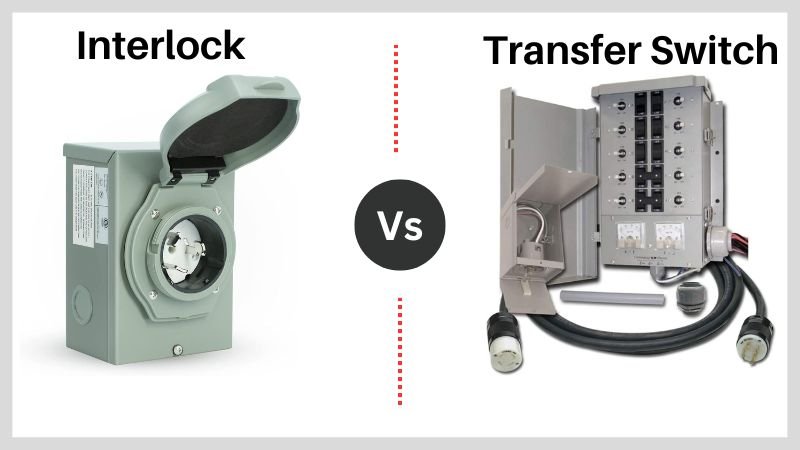
The lights flicker, then plunge your home into darkness. The hum of the refrigerator fades, and the digital clock on the microwave goes blank. A power outage. For many, it's an inconvenience. For you, perhaps, it's a call to action. You've got a generator, or you're planning to get one, and you understand that simply plugging it into an outlet is a recipe for disaster. This brings us to the crucial safety devices that allow you to connect your generator to your home's electrical system: Interlock Kits vs. Transfer Switches: A Comparison. Both are code-compliant, proven methods to ensure your home runs safely during an outage, but they go about it in very different ways.
Choosing between an interlock kit and a transfer switch isn't just about cost; it's about control, convenience, and how you envision powering your home when the grid goes dark. Let's illuminate the path forward.
At a Glance: Interlock Kits vs. Transfer Switches
- Interlock Kits: Mechanical safety device on your main electrical panel. More affordable, offers flexibility to power any circuit in the panel (one at a time, depending on generator capacity), but requires manual operation.
- Transfer Switches: Separate electrical device, often housed in its own enclosure. Can be manual or automatic. More expensive, powers a pre-selected group of essential circuits, but offers automation and easier load management.
- Safety First: Both prevent dangerous "backfeeding" into the utility grid, protecting utility workers and your equipment.
- Professional Installation is Non-Negotiable: Regardless of your choice, a qualified electrician is essential for safe, code-compliant setup.
The Invisible Threat: Why You Can't Just Plug It In
Before we dive into the nuts and bolts of each system, it's vital to understand why these devices exist. When your power goes out, the utility lines can still be live, especially if crews are working to restore power. If you were to plug your generator directly into an outlet in your home – a dangerous practice known as "backfeeding" – your generator's power would flow back out onto the utility grid. This poses a lethal risk to utility workers who might be repairing lines, unaware they're electrified by your generator. Beyond the human cost, backfeeding can also cause severe damage to your home's electrical system and the utility infrastructure.
Both interlock kits and transfer switches are specifically designed to prevent this exact scenario. They create a "break-before-make" system, ensuring that your home is either connected to utility power or generator power, never both simultaneously. This is the fundamental principle of safe generator connection.
Option 1: The Nimble Interlock Kit – Control at Your Fingertips
Imagine being the conductor of your home's power during an outage. An interlock kit gives you that baton.
What is an Interlock Kit?
At its heart, an interlock kit is a clever mechanical safety device installed directly onto the front cover of your existing main electrical service panel. It’s essentially a metal plate or slider that physically prevents two specific breakers from being "ON" at the same time: your main utility breaker and the dedicated generator breaker.
How It Works
When the power goes out, the process is straightforward:
- Turn Off Utility: You manually switch your main utility breaker to the "OFF" position. This completely disconnects your home from the grid.
- Slide and Engage: The interlock mechanism physically slides into a position that then allows you to turn your dedicated generator breaker "ON."
- Power Up: Your generator's power now flows into the main bus bars of your electrical panel.
- Select Circuits: Here’s where the flexibility comes in: you can now selectively turn on any individual branch circuit breakers in your panel, managing the load based on your generator's capacity. Need the fridge on for a bit, then the well pump? You decide.
This direct control means that a sufficiently sized generator can potentially power any circuit in your entire panel, giving you immense flexibility to prioritize and cycle loads. If you want to learn more about generator interlock kits and how they work, dive deeper into the specifics of this versatile solution.
The Upsides of Interlock Kits
- Cost-Effective: This is often the biggest draw. Parts for interlock kits typically cost a modest $50 to $150, making them significantly more affordable upfront than most transfer switches.
- Simplicity & Space-Saving: No need for a separate sub-panel or bulky box on your wall. The kit integrates neatly into your existing electrical panel, saving space and preserving your home's aesthetics.
- Unrivaled Flexibility: You're not tied to pre-selected circuits. You have direct control over every breaker in your main panel. This allows you to prioritize essential loads and even cycle less critical items (like a microwave or hair dryer) on and off as needed, maximizing your generator's output.
- Customization: Interlock kits are often custom-made to fit specific panel brands and models, ensuring a perfect, compatible fit. They can even be designed to interlock multiple components like AC units or EV chargers, offering broader home energy management.
What to Consider with Interlock Kits
- Manual Operation: There's no automation here. You must physically go to your panel, flip breakers, and manage loads.
- Panel Modifications: Installation requires internal modifications to the main electrical panel. This must be done by a qualified electrician, and the kit must be specifically approved for your panel brand and model to ensure code compliance.
- No "Always On" Circuits: Because you're selecting circuits dynamically, there's no pre-defined set of "always on" essential circuits, which might be a downside for those seeking a set-and-forget solution.
Option 2: The Robust Transfer Switch – Dedicated Power Management
For those who prefer a more structured, or even automated, approach to backup power, the transfer switch is a formidable contender.
What is a Transfer Switch?
A transfer switch is a separate, dedicated electrical device, usually housed in its own enclosure, installed either adjacent to your main electrical panel or sometimes outside. Think of it as a mini-electrical panel – a sub-panel – that specializes in managing power transfer for a specific set of circuits.
How It Works
During installation, typically 6 to 10 of your most essential circuits (like your furnace, refrigerator, some lights, and a few outlets) are disconnected from your main panel. These circuits are then rewired directly into the transfer switch.
- Manual Transfer Switch (MTS): When an outage occurs, you start your generator, then go to the MTS and manually toggle a switch from "UTILITY" to "GENERATOR." This instantly switches power only to those pre-wired essential circuits.
- Automatic Transfer Switch (ATS): These are the kings of convenience. When an outage is detected, the ATS automatically disconnects from utility power, signals your generator to start, and then switches power over to your pre-selected circuits, all without you lifting a finger. When utility power returns, it reverses the process.
This system ensures that your generator's power is always directed to a managed, pre-determined load. Knowing how to choose the right generator to pair with your setup is critical, as a transfer switch relies on its capacity for these dedicated circuits.
The Upsides of Transfer Switches
- Automation (ATS): For many, this is the paramount advantage. An automatic transfer switch provides unmatched convenience, detecting outages and seamlessly restoring power without user intervention.
- Load Management (MTS & ATS): By limiting power to a pre-selected group of circuits, transfer switches inherently manage your generator's load. This prevents accidental overloading and ensures your most vital systems stay powered, typically ideal for larger properties (e.g., 4,000+ square feet) and higher power loads.
- Compliance: In some local building codes and regulations, the use of transfer switches (especially UL 1008 listed factory-assembled units) may be specifically required or preferred, particularly for larger generator installations.
- Less Invasive to Main Panel: While the overall installation is more complex, wiring to a separate sub-panel can sometimes be less disruptive to an older or tightly packed main electrical panel itself, compared to the internal modifications of an interlock kit.
What to Consider with Transfer Switches
- Higher Cost: This is the most significant hurdle. Residential automatic units can range from $600 to $2000 for parts alone, while manual transfer switches typically cost $500 to $1,500 depending on the number of circuits included. Installation costs are also higher due to the increased wiring complexity.
- Limited Flexibility: You can only power the circuits that are pre-wired into the transfer switch. You lose the ability to dynamically switch power to other circuits in your home.
- Installation Complexity: A transfer switch acts as a separate sub-panel, requiring dedicated wiring runs from your main panel to the switch, and then from the switch to each essential circuit. This is a job for a qualified electrician and can be more involved.
- Ongoing Maintenance: Automatic transfer switches, in particular, require regular maintenance and testing to ensure sensors and mechanical components are functioning correctly. This adds an ongoing fiscal responsibility.
Head-to-Head: Interlock Kit vs. Transfer Switch – A Feature Showdown
Let's break down the key differences to help you visualize the comparison:
| Feature | Interlock Kit | Transfer Switch |
|---|---|---|
| Material Cost | $50 - $150 (Parts only) | $500 - $2000 (Parts only, depending on type/circuits) |
| Installation | Internal main panel mod; less wiring | Separate sub-panel; extensive dedicated wiring |
| Flexibility | Power any circuit (selectively) | Power pre-selected essential circuits only |
| Automation | Strictly manual | Manual (MTS) or Automatic (ATS) |
| Space | No additional space required | Separate enclosure on wall/outside |
| Load Mgmt. | Manual cycling by user | Pre-defined circuits; prevents overloading |
| Maintenance | Virtually none after installation | Regular testing/maintenance for ATS units |
| Code Compliance | Panel-specific approval required | Often UL 1008 listed; sometimes locally mandated |
| Best For | Budget-conscious, hands-on user, smaller homes | Convenience, larger homes, specific load management |
Making Your Decision: Which System is Right for You?
Choosing between these two excellent safety solutions boils down to your personal priorities, budget, and specific home needs. There's no single "best" answer, only the best fit for you.
1. Your Budget: The Bottom Line
- Interlock Kits: If cost is your primary concern, an interlock kit is almost always the more economical choice. The parts are inexpensive, and while professional installation is still required, the labor might be slightly less than for a full transfer switch setup.
- Transfer Switches: Be prepared for a higher investment. The cost difference can be substantial, especially for automatic models and systems designed for many circuits.
2. Your Power Needs: Essential vs. Whole Home
- Interlock Kits: Ideal if you want the flexibility to power various circuits dynamically, potentially giving you access to nearly all your home's circuits, provided your generator can handle the load. You're willing to manually manage what's on and off.
- Transfer Switches: Best if you know exactly which 6-10 circuits are absolutely essential, and you want those powered without fuss. It simplifies load management but limits your options.
3. Your Desire for Automation & Convenience
- Interlock Kits: This is a hands-on solution. You'll be flipping breakers and managing your power manually. If you enjoy that level of control, or don't mind the process, it's great.
- Manual Transfer Switches (MTS): Still manual, but a simpler "flip one switch" action for the generator power, rather than selecting individual breakers.
- Automatic Transfer Switches (ATS): If "set it and forget it" is your mantra, and convenience is paramount, an ATS is unmatched. It's the closest thing to having a whole-house standby generator (which often comes with an ATS).
4. Your Home's Size & Electrical System
- Interlock Kits: Generally well-suited for smaller to medium-sized homes where managing loads manually across the entire panel is feasible. The internal modification needs to be compatible with your existing panel, so older or very unique panels might pose a challenge for finding an approved kit.
- Transfer Switches: Often preferred for larger homes with more critical circuits, or when you want a dedicated solution for a specific set of essential loads. The separate sub-panel nature can sometimes simplify wiring, especially if your main panel is older or full.
5. Local Codes & Regulations
Before making any decision, always check with your local building department and a qualified electrician. Some local jurisdictions may have specific requirements or preferences for one system over the other, especially for new construction or certain generator sizes. Understanding local electrical codes is a critical step in any home electrical project.
Installation: Do Not Attempt This Yourself!
Regardless of whether you choose an interlock kit or a transfer switch, this is not a DIY project. Connecting a generator to your home's electrical system involves high voltage and complex wiring that must comply with strict electrical codes (like the National Electrical Code - NEC).
Always hire a qualified, licensed electrician. They will ensure:
- Safety: The system is installed correctly, eliminating any risk of backfeeding.
- Code Compliance: Your installation meets all local and national electrical safety standards, protecting you from fines, insurance issues, and hazards.
- Proper Sizing: The system is correctly matched to your generator and home's electrical needs.
An improper installation could lead to serious injury, electrocution, fire, or damage to your home and generator. Your safety, and the safety of utility workers, depends on professional installation. For more general advice, be sure to review crucial generator safety tips that extend beyond installation.
Common Questions & Misconceptions
"Can I just use a heavy-duty extension cord from my generator to my fridge?"
Absolutely not. This is backfeeding waiting to happen, even if you try to be careful. Never plug a generator directly into a wall outlet. This creates a direct path for generator power to feed back into the utility grid, posing a lethal threat to utility workers and potentially damaging your home's appliances and the generator itself.
"Is one system inherently 'safer' than the other?"
When installed correctly by a qualified electrician, both interlock kits and transfer switches are equally safe and code-compliant. They both effectively prevent backfeeding. The "safety" comes from the proper installation and adherence to standards, not from the type of device itself.
"What if my main electrical panel is very old or full?"
An older or completely full main electrical panel might make installing an interlock kit challenging or impossible, as it requires specific internal modifications and compatible parts. In such cases, a transfer switch might be a more practical solution, as it's a separate unit that ties into your panel with specific wiring rather than modifying its internal structure.
"Do I need a separate power inlet box for my generator?"
In almost all cases, yes. Whether you choose an interlock kit or a transfer switch, your generator typically connects to your home via a weather-resistant power inlet box installed on the exterior of your home. A heavy-duty generator cord then connects the generator to this inlet box, keeping the generator safely outdoors and away from carbon monoxide concerns.
Beyond the Basics: Enhancing Your Backup Power Strategy
While interlock kits and transfer switches are critical for safe generator connection, they are just one piece of your overall backup power plan. Consider factors like:
- Generator Sizing: Matching your generator's wattage output to your home's actual power needs is crucial. Overloading your generator can damage it and interrupt your power.
- Fuel Type & Storage: Do you prefer gasoline, propane, natural gas, or diesel? Each has its pros and cons regarding storage, availability, and run time.
- Maintenance: Regular maintenance of your generator is key to ensuring it starts reliably when you need it most.
Understanding these broader considerations ensures you're not just safely connected, but also reliably powered during an outage. For a more expansive view on keeping your home powered, check out exploring various home backup power options available today.
Your Next Step Towards Reliable Power
You're now armed with the knowledge to make an informed decision about safely connecting your generator. The choice between an interlock kit and a transfer switch isn't about right or wrong; it's about finding the solution that best aligns with your budget, lifestyle, and power requirements.
Your most important next step? Consult with a qualified, licensed electrician. Share your needs, discuss your budget, and ask for quotes for both options. They can assess your home's electrical system, verify local code requirements, and recommend the safest and most efficient solution for your specific situation. With their expertise, you can confidently prepare your home for the next power outage, ensuring peace of mind and safe, reliable power.